
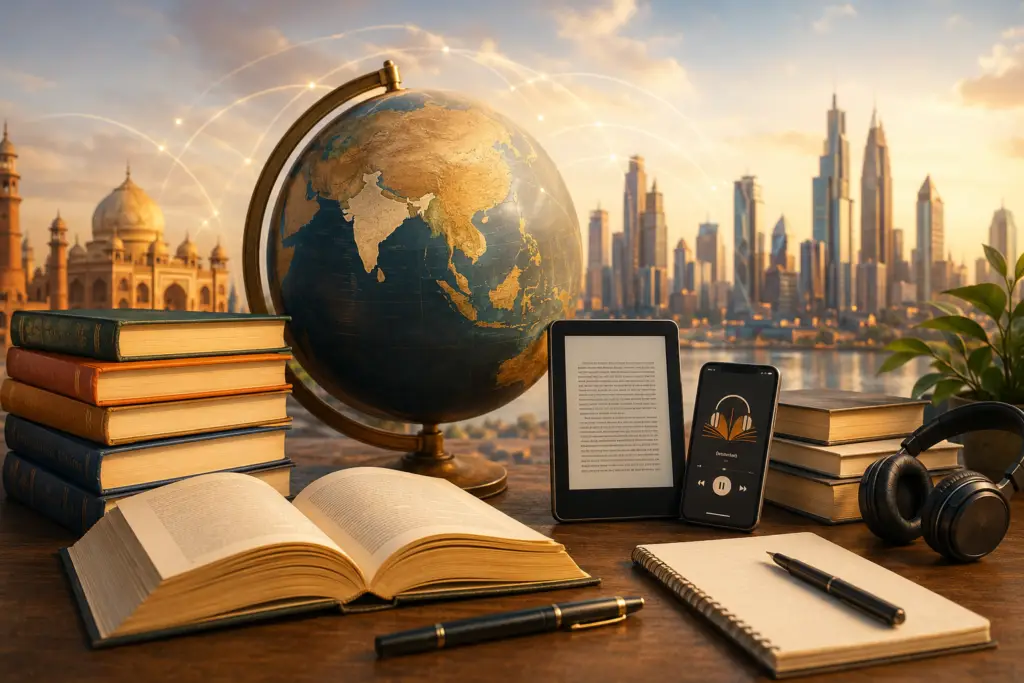
Exploring how Indian authors are shaping global narratives and the evolving landscape of modern publishing.
July 22, 2026 • 8 min read
Indian publishing is in the middle of a quiet transformation. For decades, the industry ran on a fairly predictable model: a handful of major houses, a few dominant languages, and a path to readers that ran almost entirely through bookstores. That model hasn’t disappeared, but it’s no longer the only path — or even the fastest one. Between self-publishing platforms, regional-language growth, digital reading habits, and Indian authors increasingly finding audiences abroad, the shape of the industry is changing in ways that are worth paying attention to.
A Genuinely Multilingual Market
India publishes in more languages than almost any other country in the world, and that diversity is becoming a bigger part of the industry’s identity rather than a side note to it. Publishers are investing more in translation — moving strong regional-language titles into Hindi and English, and increasingly the other way around, bringing English-language bestsellers into regional markets. For authors, this means a book’s first audience no longer has to be its only audience. A novel written in Malayalam or Bengali has a real, growing path to national and even international readers through translation deals that simply weren’t as common a decade ago.
Self-Publishing Has Changed Who Gets to Be an Author
Traditional publishing in India, like everywhere, has always been selective. Self-publishing platforms have changed that equation significantly, giving authors a way to reach readers directly without waiting for a gatekeeper’s approval. This has been especially significant for genre fiction, niche nonfiction, and first-time authors who might have struggled to get attention from major houses. Some of the country’s most talked-about breakout titles in recent years started as independently published books that built an audience before a traditional publisher ever got involved.
Digital Reading Is No Longer a Side Channel
E-books and audiobooks were once treated as a secondary format in India — nice to have, not essential. That’s shifted. Rising smartphone use, more affordable data, and platforms built specifically for Indian readers have made digital reading a primary way many people, especially younger readers, discover and consume books. Audiobooks in particular are growing quickly, helped by the popularity of narration in Hindi and regional languages, not just English.
Indian Authors on the Global Stage
Indian writers have long had a place in global literary conversation, but the nature of that presence is shifting. It’s no longer just a small set of internationally established names — a wider range of Indian authors, writing across genres from literary fiction to fantasy to nonfiction, are getting international deals, translation rights, and global distribution earlier in their careers. International publishers and literary agents are paying closer attention to the Indian market, not just as a source of stories, but as a genuinely large and growing readership in its own right.
What’s Driving the Change
A few forces are pushing this shift forward at the same time:
- A growing, younger reading population with different habits and expectations than previous generations of readers.
- Better publishing infrastructure, including print-on-demand, more accessible ISBN registration, and digital distribution tools that lower the barrier to entry for new authors and small publishers.
- Social media and online reading communities, which have become powerful, organic marketing channels — sometimes more influential than traditional book marketing.
- Increased international interest in stories and perspectives from India, as global publishers look beyond a narrow set of familiar markets.
What This Means for Authors
For writers building a career today, this shifting landscape opens up more paths than existed before. Traditional publishing, self-publishing, translation deals, and international rights are no longer separate, sequential stages — many authors are mixing and matching these paths depending on what suits a particular book. An author might self-publish a first title to build an audience, use that momentum to land a traditional deal for a second book, and later sell translation rights into another language entirely.
Final Thoughts
The future of publishing in India isn’t a single trend — it’s several converging at once: multilingual growth, digital-first reading habits, a lower barrier to entry for new authors, and a bigger seat at the global table. For authors watching this space, the opportunities are less about picking the “right” traditional path and more about understanding the range of paths now available, and choosing the mix that fits the story they’re trying to tell — and the readers they’re trying to reach.