
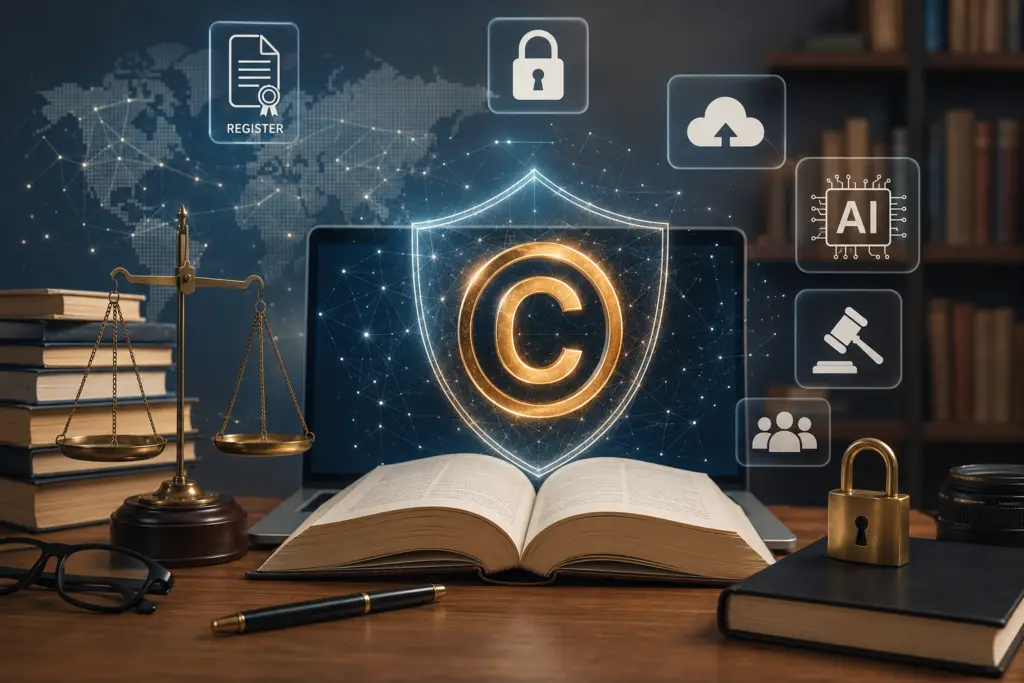
Copyright for authors made simple: learn what copyright protects, why registration matters, and 7 practical steps to protect your books online.
Read time: 8 min
Understanding Copyright in the Digital Age
Essential knowledge every author needs to protect their creative work.
Copyright for authors is no longer optional knowledge. Publishing looks nothing like it did twenty years ago. E-books, print-on-demand, audiobooks, self-publishing platforms and AI tools have changed how creative work moves through the world, and how easily it can be copied, repurposed or misused. Understanding your rights is now part of the job.
Here’s what every writer should know about protecting their work in an age where content travels faster than ever. If you’re also planning your next release, explore the author resources at Leaf Press Books.
What Copyright for Authors Actually Protects
Copyright protects the expression of an idea, not the idea itself. Two authors can write books about grief, love or entrepreneurship, and copyright doesn’t stop that. What it protects is your specific words, structure and creative choices: your manuscript, your exact phrasing and your unique arrangement of ideas.
In most countries, copyright exists automatically the moment you create an original work in a fixed form. You don’t need to register it for it to exist. But that doesn’t mean registration is pointless. For a global overview, see the World Intellectual Property Organization’s copyright guide.
Why Registration Still Matters
Even where copyright is automatic, formal registration with your country’s copyright office, such as the U.S. Copyright Office, creates an official public record of ownership. This matters enormously if you ever need to prove authorship in a dispute, pursue legal action against infringement, or license your work with confidence.
Think of automatic copyright as owning a house and registration as holding the deed. The house is yours either way, but the deed makes it far easier to prove in court.
The New Risks of the Digital Age
Piracy and Unauthorized Distribution
E-books and PDFs can be copied and shared instantly. File-sharing sites and unofficial “free download” pages are a persistent problem for authors, particularly in the early months after release when sales momentum matters most.
AI Training and Scraping
One of the newest and most contested issues in publishing is whether AI companies can use copyrighted books to train language models without permission. This is an active legal and policy battleground worldwide, with ongoing lawsuits, licensing negotiations and shifting regulations. Groups like the Authors Guild track these developments, and authors should stay informed as the rules are still being written.
Plagiarism Across Borders
Digital publishing means your work can be copied and republished under someone else’s name in a different country within hours. Cross-border enforcement is harder than domestic enforcement, which makes proactive protection more important than ever.
7 Practical Steps for Copyright for Authors
- Register your copyright as soon as a work is finalized, not just when it’s published.
- Use clear copyright notices on every edition: print, digital and audio.
- Read your publishing contracts carefully. Understand exactly which rights you’re licensing (print, digital, translation, film) and for how long.
- Monitor for infringement with tools like Google Alerts, reverse image search for cover art, or dedicated anti-piracy services.
- Understand fair use or fair dealing in your jurisdiction, so you know both your rights and the limits of what others can legally borrow from your work.
- Keep dated drafts and records. Version histories, saved drafts and timestamps can serve as evidence of original authorship.
- Use watermarking on review copies and sample files to discourage unauthorized sharing.
When to Involve a Lawyer
Simple registration and monitoring can often be done independently. But if you discover unauthorized use of your work, or you’re negotiating a contract involving multiple rights (film, translation, serialization), it’s worth consulting an intellectual property attorney. Copyright law varies significantly by country, and the cost of a consultation is small compared to the value of a mishandled rights agreement.
Final Thoughts
Copyright hasn’t gotten weaker in the digital age. It’s gotten more complicated to enforce. The tools available to protect creative work have grown alongside the risks. Authors who understand copyright for authors, register early and stay alert to how their work moves online put themselves in the strongest possible position to keep control of what they’ve created.
Ready to publish with confidence? Visit Leaf Press Books to learn how we support authors from manuscript to market.